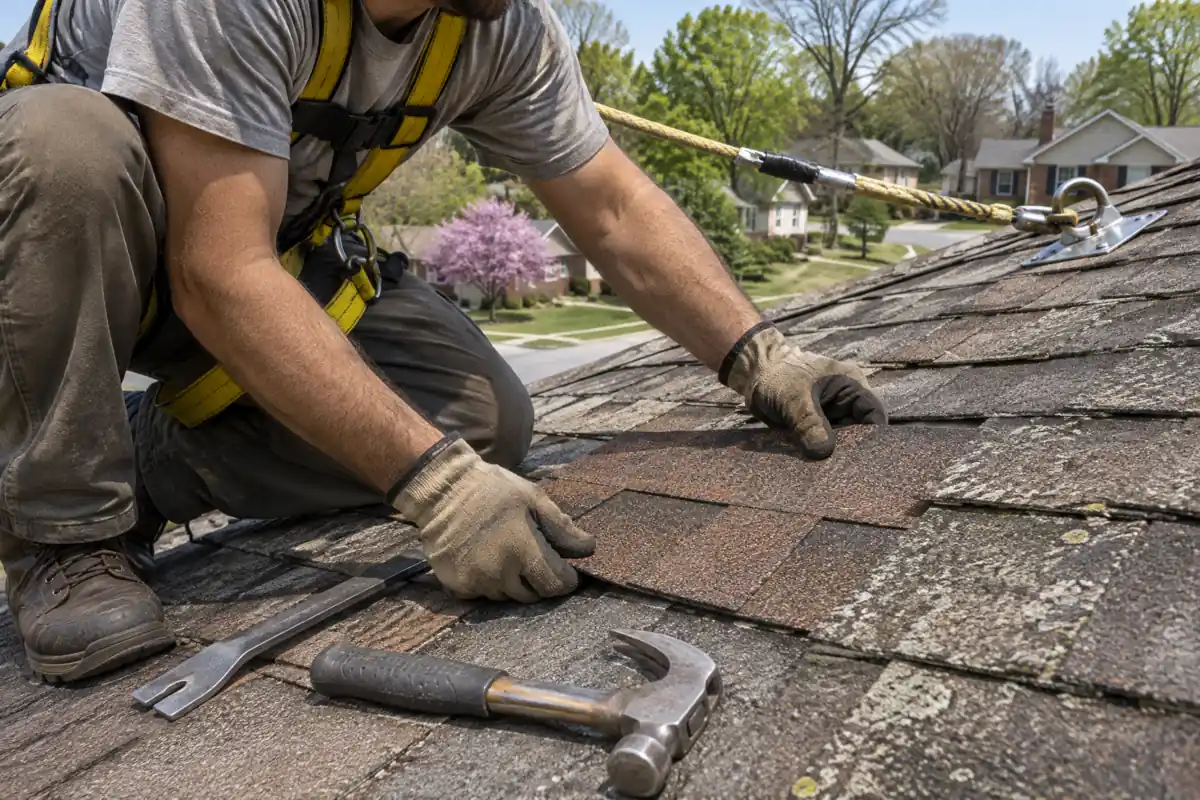
What does a roof repair in Tulsa usually involve?
Most repair calls in the Tulsa area come down to a handful of jobs: shingles torn off by a straight-line wind, a cracked rubber boot around a plumbing vent, flashing that has pulled away from a chimney or wall, or a small area of decking that has gone soft under a long-running leak. A repair replaces or reseals the failed part and the materials around it, so the roof keeps shedding water the way it was designed to.
A good repair is matched to what is already on the house. That means finding shingles of the same type and close in color, using the right nails in the right place, and lapping new pieces under the course above so water runs over, not into, the patch. On older roofs a roofer may warn you that brittle shingles crack when lifted, which can turn a small repair into a larger one.
Signs your roof needs repair, not just watching
- Shingles or pieces of shingle in the yard after a windy night.
- Bare black patches, lifted tabs or a line of creased shingles along one slope.
- Granules collecting at the bottom of downspouts in quantity, especially after hail.
- A brown ring on a ceiling, a damp smell in the attic or daylight through the decking.
- Flashing that is bent, rusted through or no longer sealed where it meets brick or siding.
- Exposed nail heads that have backed out of the shingles.
Any one of these can let water in during the next heavy storm. Oklahoma spring storms often come in clusters, so a small opening rarely stays small for long.
How the repair is done
- Inspection. The roofer looks at the roof surface and, where possible, the attic, to trace where water is getting in. Leaks often show up several feet from where they start.
- Scope and options. You should be told what failed, what it will take to fix, and whether the rest of the roof is likely to hold up.
- Repair. Damaged shingles are removed, any wet or rotten decking is cut out and replaced, underlayment is patched, and new shingles or flashing are installed and sealed.
- Clean-up and check. Nails and debris are picked up from the yard and gutters, and the repaired area is checked for proper overlap and seal.
What affects the cost and time of a roof repair?
Prices vary from provider to provider and job to job, so ask for a written estimate before work starts. The things that move the number most are:
- Access and pitch. A steep two-story roof needs more safety gear and more time than a low-slope ranch house.
- Hidden damage. Soft decking or wet insulation found once shingles come off adds materials and labor.
- Matching materials. Discontinued shingle lines can be hard to match, and some homeowners choose to repair a whole slope for appearance.
- Flashing and penetrations. Chimneys, skylights and wall junctions take longer than open field shingles.
- Demand. In the days after a big hailstorm, schedules fill fast across the metro.
Many straightforward repairs are finished in a few hours once a crew is on site. Larger repairs that involve decking or a chimney can take a day.
What to do before the roofer arrives
Move furniture and electronics away from any drip, put a bucket under it and, if water is pooling in a sagging ceiling, keep people clear of that spot. Take photos of the ceiling, the attic if you can safely get to it, and anything you can see from the ground. Those photos help the roofer and are useful if you later open an insurance claim. Do not climb onto a wet or storm-damaged roof yourself.
When is a roof repair an emergency?
Treat it as urgent if water is coming through a light fixture, the ceiling is bulging, a tree limb has punctured the roof deck, or a large section of shingles has gone and more rain is forecast. In those cases ask for a temporary tarp or emergency dry-in first and the permanent repair second. Our emergency roof repair page covers what that involves.
Repair or replace?
If damage is limited to one area and the rest of the roof is sound, repair is usually the sensible choice. If the shingles are near the end of their life, damage is spread across several slopes, or you keep calling about new leaks, replacement may cost less over the next few years. The repair or replace guide sets out the trade-offs side by side.
Checking the roofer you hire
Oklahoma requires roofing contractors to be registered with the Construction Industries Board. Ask the provider for their registration number and proof of insurance before any work begins, and get the scope and price in writing.
Questions people ask
Can one missing shingle cause a leak?
Yes. A single missing shingle exposes the nails and underlayment beneath it, and wind-driven rain can get under the courses around it. It is worth replacing quickly, especially before a storm.
How long does a typical roof repair take?
A small repair such as a few shingles or a vent boot is often done in a few hours once a crew arrives. Repairs that involve replacing decking or rebuilding flashing around a chimney can take most of a day.
Will a repaired area match the rest of my roof?
A roofer will try to match the shingle type and color, but weathered shingles fade, so a new patch can look slightly different at first. Ask to see the proposed shingle before the work starts.
Should I go into my attic to look for the leak?
Only if you can do it safely, stepping on joists and not on the ceiling drywall between them. Photos of wet spots, stained decking or daylight are useful to the roofer.
Do I need a permit for a roof repair in Tulsa?
Rules depend on the city and the size of the job. Small repairs often do not need one, while a full re-roof usually does. Ask the roofer whether a permit is needed and who will pull it.