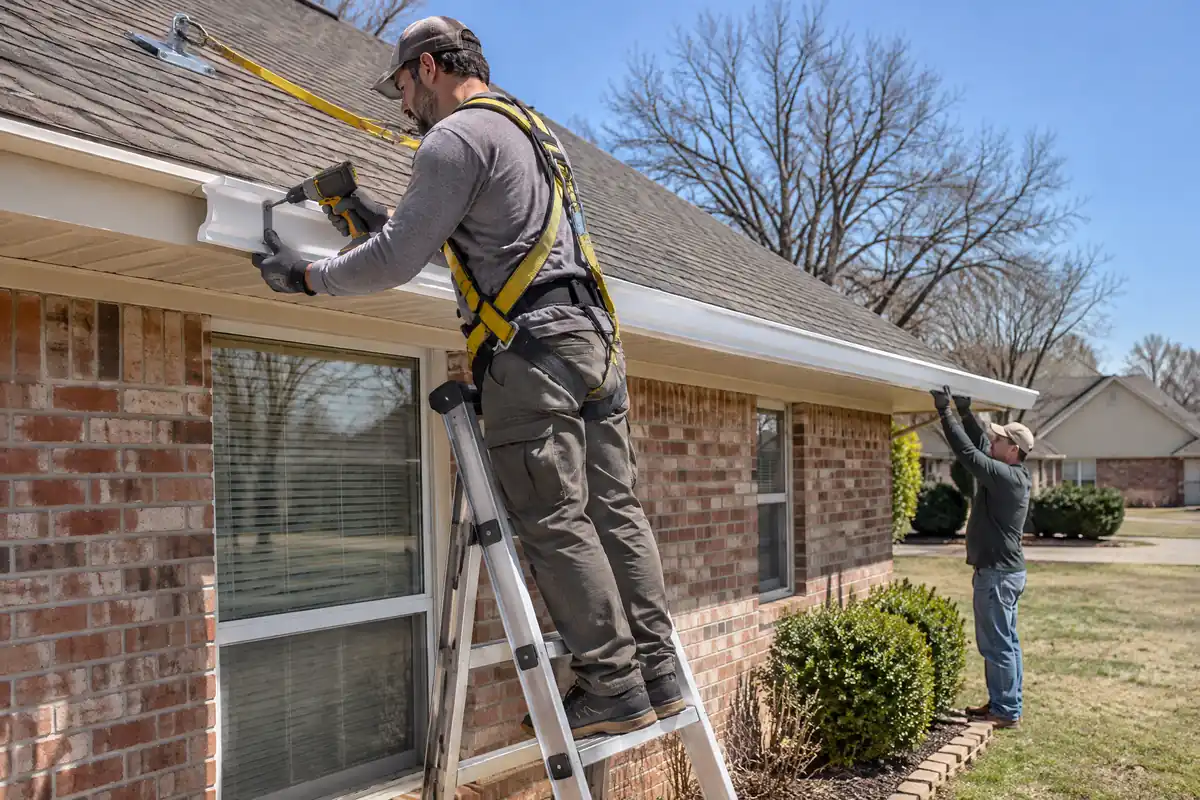
Why gutters matter in Oklahoma
Tulsa's thunderstorms can drop a lot of rain in a short time. Without working gutters, that water pours off the eaves, splashes against siding, erodes flower beds and soaks the soil next to the foundation. The expansive clay soils common in this part of Oklahoma swell when wet and shrink when dry, so keeping water away from the foundation is about more than tidiness.
Common gutter problems
- Hail dents. Dented gutters still carry water, but dents are a useful sign of hail size, and gutters are often included in a hail claim.
- Sagging or pulling away from the fascia because hangers have loosened or the fascia board has rotted.
- Leaking joints and corners on sectional gutters.
- Overflowing because gutters or downspouts are too small, blocked by leaves or pitched the wrong way.
- Downspouts dumping water next to the foundation instead of carrying it away.
Seamless versus sectional gutters
| Type | How it is made | Pros | Cons |
|---|---|---|---|
| Seamless aluminum | Formed on site from a coil to the exact length | Few joints to leak, many colors | Needs a crew with a gutter machine |
| Sectional aluminum or vinyl | Pre-cut lengths joined together | Cheaper, DIY-friendly | More joints that can leak |
| Steel | Heavier gauge, often galvanized | Stands up to dents better | Can rust if the coating is damaged |
| Copper | Soldered seams | Very long life, distinctive look | High cost |
Sizing gutters for heavy rain
Many homes have 5-inch K-style gutters. On large or steep roofs, or where valleys pour a lot of water into one corner, 6-inch gutters and 3-by-4-inch downspouts handle Oklahoma downpours better. A provider should look at where water concentrates, not just measure the eaves.
Gutter guards
Guards reduce cleaning where trees overhang the roof, which is common in established neighborhoods. Mesh guards keep out most debris; solid "reverse curve" covers work differently and can overflow in very heavy rain. Some guards can affect shingle warranties if they slide under the first course, so ask how they attach.
Gutters and roof work together
If you are replacing the roof, it is often the right time to replace old or damaged gutters too, because drip edge and gutters work as a system. Fascia boards rotted by overflowing gutters can be replaced at the same time.
Cleaning and upkeep
Clean gutters at least in late fall after the leaves fall and again in spring. Check downspout extensions after mowing. After a hailstorm, look at gutter dents and granules collected in the gutters as clues to roof damage.
Fascia and soffit repairs
Gutters hang from the fascia board, so when gutters overflow for years, the fascia behind them rots and hangers lose their grip. During gutter replacement, a provider should check the fascia and any soffit vents behind it, replace soft wood, and make sure the drip edge laps into the gutter so water cannot run down behind it.
Downspout placement
A long run of gutter with one downspout can overflow at the far end in a heavy storm. Adding a downspout, or moving one closer to where a valley pours water, often fixes overflow without replacing the whole system. Underground drains can carry water further from the house, but they need clean-outs, because leaves and granules can block them over time.
Questions people ask
Are seamless gutters worth it?
For most homes, yes. Fewer joints mean fewer leaks, and they are cut to fit each run of the house.
Will insurance replace hail-dented gutters?
Gutters are often included in a hail claim when the storm damaged them, but coverage depends on your policy and the adjuster's findings.
How far should downspouts discharge from the house?
Several feet away from the foundation is a common recommendation, using extensions, splash blocks or underground drains where suitable.
Do I need gutter guards?
If trees overhang the roof, guards can cut down on cleaning and overflow. They still need occasional checking.